Table of Contents
- Why Your Garage Door Won’t Close All the Way
- Safety First: When to Stop and Call a Professional
- Garage Door Safety Sensor Troubleshooting
- Garage Door Limit Switch Adjustment
- Garage Door Reverses Before Closing: Diagnosis and Fix
- Garage Door Spring Lifespan and When Springs Fail
- Other Common Causes and Quick Fixes
- When to Call a Garage Door Technician
- Frequently Asked Questions
Last Updated: October 17, 2026
Why Your Garage Door Won’t Close All the Way
A garage door that won’t close all the way is one of the most common issues homeowners face: the door stops partway down, reverses before fully closing, or leaves a gap at the bottom.
The good news: your garage door won’t close all the way because something is blocking the closing cycle, and that something is usually simple to identify and fix.
This guide covers the most common causes, safety sensors, limit switches, springs, and basic mechanical issues, so you’ll know whether you can handle the repair or when to call a professional.
Safety First: When to Stop and Call a Professional
Garage door springs are under extreme tension, and a snapped spring can cause serious injury or death.
The same applies to the garage door cable. If it’s frayed, broken, or hanging loose, the door could fall unexpectedly.
If your door weighs more than 400 pounds or was installed before 2000, call a technician before attempting repairs.
When to call a professional:
- You hear a loud bang or snap
- The door suddenly feels much heavier
- The cable is visibly damaged or loose
All Seasons Garage Door offers free quotes and around-the-clock emergency service.
Garage Door Safety Sensor Troubleshooting
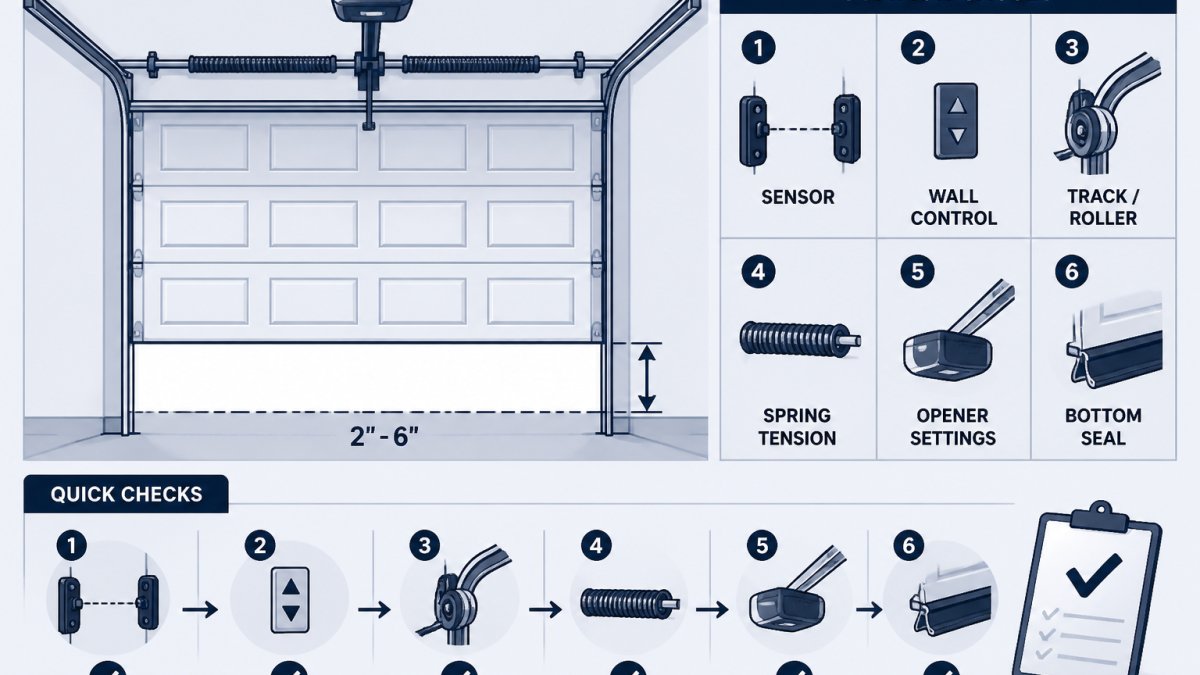
Safety sensors are the most common reason a garage door won’t close all the way. These photo-eye sensors sit on each side of the door frame near the bottom.
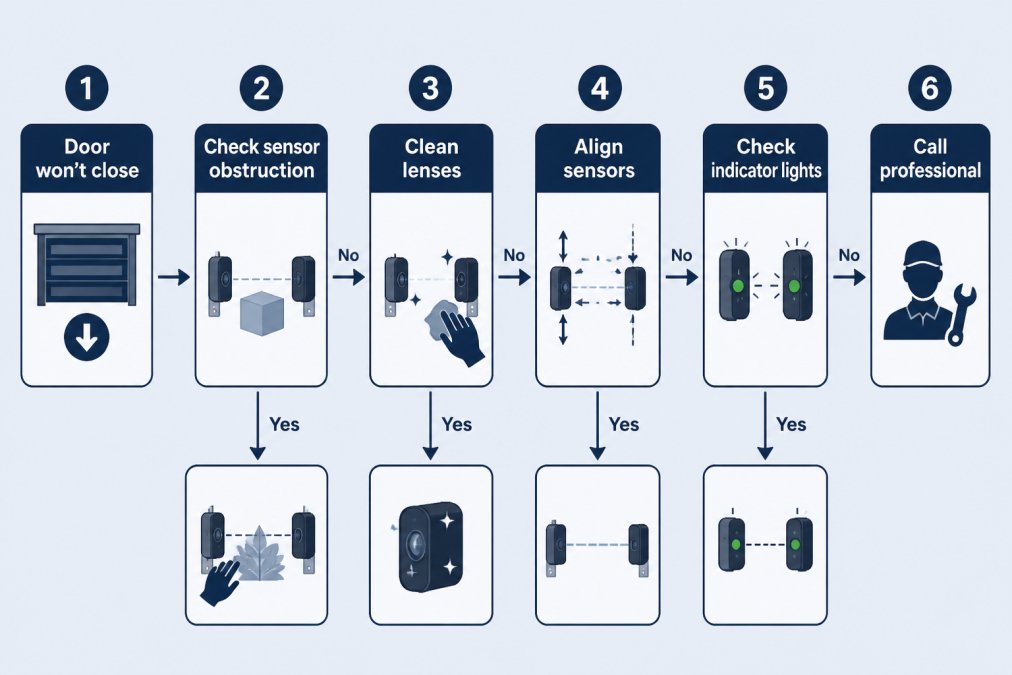
This safety feature prevents the door from crushing a person, pet, or object, but when sensors malfunction they stop the door from closing even when the path is clear.
Check for Objects Blocking the Sensors
Walk the length of the garage door opening. Look for anything in the sensor beam path: boxes, tools, debris, pet toys, or even spider webs.
Remove anything blocking the sensors and test the door. If it closes, you’re done; if not, move to the next step.
Clean the Sensor Lenses
Dust and dirt on the sensor lenses are the second most common cause of closure problems, since garage dust builds up and blocks the beam.
Here’s how to clean them:
- Unplug the garage door opener from the outlet
- Locate both sensors, one on each side of the door frame, about 4-6 inches from the floor
- Wipe each lens gently with a soft, dry cloth (a slightly damp cloth with water only for stubborn dirt, no chemicals)
- Plug the opener back in and test the door
If the door closes normally after cleaning, the sensors were dirty. If it still won’t close, they may be misaligned.
Align the Safety Sensors
Misaligned sensors can’t see each other’s beam. The door will stop and reverse even when the path is clear.
How to check alignment:
- Look at the indicator light on each sensor (usually red or green)
- Both sensors should show the same color light
- If one is a different color, they’re misaligned
How to realign the sensors:
- Loosen the mounting bracket on the misaligned sensor (usually a small bolt or screw)
- Adjust the sensor slowly until both lights match
- Tighten the bracket
- Test the door
The adjustment is usually small, sometimes just a quarter turn. Don’t force it.
Check Sensor Indicator Lights
What the lights mean:
- Steady green on both sensors: Sensors are aligned and working. The problem is elsewhere.
- Red on one or both sensors: Sensors are misaligned or not receiving power.
- No light on either sensor: Check the power connection to the opener.
If both sensors show steady green but the door still won’t close, the problem is not the sensors.
Garage Door Limit Switch Adjustment
The limit switch, more accurately called the travel-limit setting on most modern openers, tells the opener where the door should stop at the bottom of its travel.
Unlike the safety sensors, which watch the doorway for obstructions, the travel limits tell the opener how far to move. A door that stops at the same short height every time, with no reversal and no blinking sensor light, is usually a travel-limit problem.
Before adjusting anything, confirm the door is not binding. With the opener disconnected (pull the emergency release handle), lift the door halfway by hand. A properly balanced door should stay in place with light effort. If it slams down or feels extremely heavy, stop, you likely have a spring or cable problem, and adjusting the opener will not fix it.
How to tell a travel-limit problem from other causes
- Door stops at the same height every cycle, no reversal: travel-limit setting is the leading suspect.
- Door starts down, then reverses immediately: safety sensor or force setting, not travel limit.
- Door closes partway, pauses, then reverses: obstruction, binding, or force setting.
Adjusting the down travel limit
Most openers made in the last 20 years use slotted screws labeled “up” and “down,” a pair of dials, or a digital menu.
- Close the door and note the gap at the floor.
- Locate the down-limit adjustment.
- Turn or press it in the smallest increment the mechanism allows, typically a quarter turn on a screw, one click on a dial, or one step in a digital menu.
- Run the door through a full close cycle and re-measure the gap.
- Repeat in single increments until the door meets the floor without compressing the bottom seal more than about half its thickness.
Do not turn the adjustment several full rotations at once, overshooting can drive the door into the floor, stressing the opener gear and cracking panels. If the door bows or the opener strains audibly at the bottom, back the adjustment off immediately.
Force settings are not the same as travel limits
Many openers also have a force (or sensitivity) adjustment, which controls how much resistance the opener pushes through before reversing.
If the door closes fully when you hold the wall button but reverses from the remote, the problem is usually the control wiring or the remote, not the limits. If it reverses on contact with a small object like a roll of paper towels, the force setting is too low or the sensors are misaligned.
After any limit adjustment, run the door through three full open-and-close cycles and watch the bottom edge. The door should meet the floor evenly across the width. If one side lands first, stop adjusting the opener and inspect the tracks and hinges, the door is binding, and no limit setting will correct that.
If the adjustment mechanism is stripped, the digital menu won’t save, or the door still stops short after several careful increments, the logic board or travel module may be failing, a technician-level diagnosis. A service call to set travel limits and verify force settings can be performed by a technician.
Garage Door Reverses Before Closing: Diagnosis and Fix
Start here:
- Check for objects in the door path (toys, tools, debris)
- Clean the sensor lenses
- Check sensor alignment (both lights should match)
- Adjust the limit switch slightly downward
If the door still reverses, the force setting may be too sensitive, the opener reverses if it feels any resistance.
How to adjust the force setting:
- Locate the force adjustment dial on the opener (check your manual, it’s usually labeled “force” or “power”)
- Increase the force slightly by turning the dial
- Test the door and repeat until it closes fully without reversing
Be careful not to set the force too high, a door with excessive force can cause injury.
If adjusting force doesn’t work, the door may have a binding issue (track misalignment or a bent roller). This requires professional service.
Garage Door Spring Lifespan and When Springs Fail
Garage door springs last 7 to 12 years on average.
Springs don’t always break suddenly. Sometimes they weaken gradually.
Signs of a failing spring:
- The door feels much heavier than normal
- The door closes slowly on one side
- You hear a loud bang or crack from the garage
If you suspect a spring problem, stop and call a professional. Replacing a garage door spring is dangerous and requires special tools.
All Seasons Garage Door specializes in safe spring replacement. We handle both torsion and extension springs.
Other Common Causes and Quick Fixes
Once you’ve ruled out the safety sensors and travel limits, work through the remaining causes in the order below, from the cheapest, safest checks to the opener’s force settings and the door’s mechanical parts. Stop as soon as the door closes fully and evenly.
1. Inspect the tracks for obstructions and alignment
With the opener disconnected (pull the emergency release), examine both vertical and horizontal tracks.
- Debris: Dirt, dried grease, and small objects in the track channel are common. Wipe the channel with a dry cloth; do not lubricate the track itself, most manufacturers specify a dry track and lubricated rollers or hinges instead.
- Bends and dents: A dent catches a roller and causes the door to bind partway down. Small dents can sometimes be eased out with a rubber mallet, but a creased or kinked track needs replacement.
- Track spacing: The gap between the left and right tracks should be even top to bottom. If one track is knocked inward, the door binds on that side, this is a professional realignment, so don’t try to bend a mounted track back with the door attached.
2. Test the wall control and remote separately
A control problem can mimic a door problem. Run these tests:
- Wall button, press and hold: If the door closes fully only while you hold the button, the opener is in constant-pressure mode, a sign that a sensor, force, or travel-limit fault is still present. Holding the button overrides the automatic close but doesn’t fix the underlying issue.
- Remote, single press: If the door closes fully on a single press but not when you hold the wall button, the wall control or its wiring is the likely fault.
- Neither control works: The problem is in the door, the sensors, or the opener logic, not the remotes.
A faulty wall control is usually a straightforward swap at the same mounting location. Match it to the opener brand and model; universal controls work on some openers but not all.
3. Check the force setting, carefully
The force setting tells the opener how much resistance to push through before reversing. Too low, and the door stops on a minor bind, a stiff seal, or cold weather; too high, and the door may not reverse when it contacts a person or object.
Do not increase force to compensate for a door that binds, a weak spring, or a misaligned track. Fix the mechanical cause first. Raising force to push a binding door through is how opener gears strip and how doors come down on objects.
If the door moves freely by hand and the sensors are aligned, a small force adjustment may be appropriate:
- Locate the force adjustment (a dial or digital menu, check the manual) and note the current setting so you can return to it.
- Increase by the smallest increment available.
- Test the door with a small object (a roll of paper towels) in its path, it must reverse on contact. If it doesn’t, reduce force immediately.
- Repeat only until the door closes reliably on its own.
4. Look for binding and uneven movement
With the door disconnected from the opener, raise and lower it by hand. A balanced door moves with light, even effort and stays where you leave it.
- Binds at one height: a track dent, a bad roller, or a seized hinge.
- Heavier going down than up: a weakened spring or a cable out of adjustment.
- Door drifts down on its own: spring tension is too low, a professional adjustment.
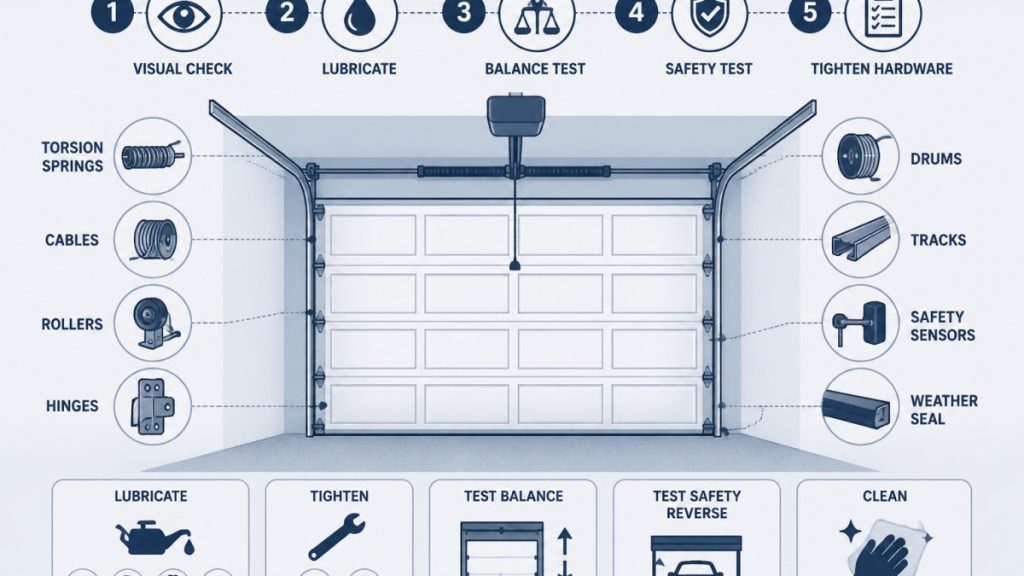
5. Inspect rollers, hinges, and cables visually
This is a look-only check. Do not loosen, remove, or adjust any cable or spring component.
- Rollers: Nylon rollers wear flat; steel rollers can seize. A seized roller skids instead of rolling and can stop the door partway.
- Hinges: Look for cracks at the hinge leaves or elongated screw holes. A hinge pulling out of the panel signals binding that needs diagnosis, not just a tighter screw.
- Cables: Frayed strands, a slack cable on one side, or a cable that has jumped its drum are stop-work conditions, cables are under high tension and can cause severe injury.
The order matters: sensors first, then travel limits, then tracks and controls, then force, and only after the door moves freely by hand. Most “won’t close all the way” calls resolve in the first two steps. If you reach the force adjustment and the door still binds, the problem is mechanical, and a technician should inspect the springs, cables, and track alignment before any further opener adjustment.
If the door still stops short after all five checks, the remaining possibilities, a failing logic board, a worn drive gear, or a spring that has lost tension, are technician-level repairs. A diagnostic service call can identify the cause.
When to Call a Garage Door Technician
Call a professional if:
- You’ve tried all the steps above and the door still won’t close
- You suspect a spring or cable problem
- The door is old or very heavy
All Seasons Garage Door responds to emergency calls 24/7, provides free quotes before any work begins, and stands behind every repair with a 100% satisfaction guarantee. Our background-checked technicians are trained on all door types and opener models.
Frequently Asked Questions
What can I do if my garage door won’t close all the way?
Start by checking if objects block the safety sensors near the floor, then clean the sensor lenses with a soft cloth. If the door still won’t close, align the sensors so the indicator lights are steady. Check the travel limit setting on the opener, it may be set too high. If these steps don’t work, the springs may be failing or the opener needs professional adjustment. Contact a technician if you’re unsure about any step or if the door reverses during closing.
Could misaligned safety sensors keep a garage door from closing all the way?
Yes. Misaligned safety sensors are one of the most common reasons a garage door won’t close completely. The sensors sit on opposite sides of the door frame near the floor and must point directly at each other. If they’re out of alignment, the door opener detects a false obstruction and reverses or stops the closing cycle. Loosen the sensor bracket slightly, adjust it until the indicator lights are steady and bright, then tighten it. Test the door to confirm it closes fully.
How long do garage door springs last?
Garage door springs typically last 7 to 12 years, depending on use and climate. A standard spring opens and closes the door about 10,000 to 20,000 times in its lifetime. If your door is older and won’t close properly, spring failure is a likely culprit. Never attempt to replace springs yourself, they are under extreme tension and can cause serious injury. A professional technician can safely replace them and test the door balance.
Why does my garage door reverse before it reaches the floor?
A door that reverses before fully closing usually signals a safety sensor issue, obstruction in the track, or an opener force setting that’s too sensitive. Check for leaves, debris, or objects blocking the sensor beam. If sensors are clear and aligned, the force limit on the opener may be set too low, causing it to reverse when the door meets slight resistance. Consult your opener’s manual for force adjustment instructions, or call a technician if you’re uncomfortable making these changes.
A garage door that won’t close all the way is frustrating, but most causes are fixable. Start with the safety sensors and limit switch, these handle the majority of closure problems. If those checks don’t solve it, the issue is likely mechanical and requires professional service. All Seasons Garage Door has been serving homeowners in this area since 2002. We’re here when you need us, with honest pricing and reliable results.