Table of Contents
- When to Replace a Garage Door: An 8-Point Checklist
- Signs You Need a New Garage Door vs. a Simple Repair
- Garage Door Repair vs Replacement: A Decision Framework
- Garage Door Replacement Cost: What Drives the Price
- Safety Checks and Urgent Warning Signs
- Insulation, Weather Sealing, and Energy Performance
- Frequently Asked Questions
Last Updated: October 16, 2026
When to Replace a Garage Door: An 8-Point Checklist
Most people replace garage door units after 15 to 30 years, but age alone doesn’t decide it. The honest answer is this: you replace a garage door when repairs stop making financial sense and safety starts becoming a question.
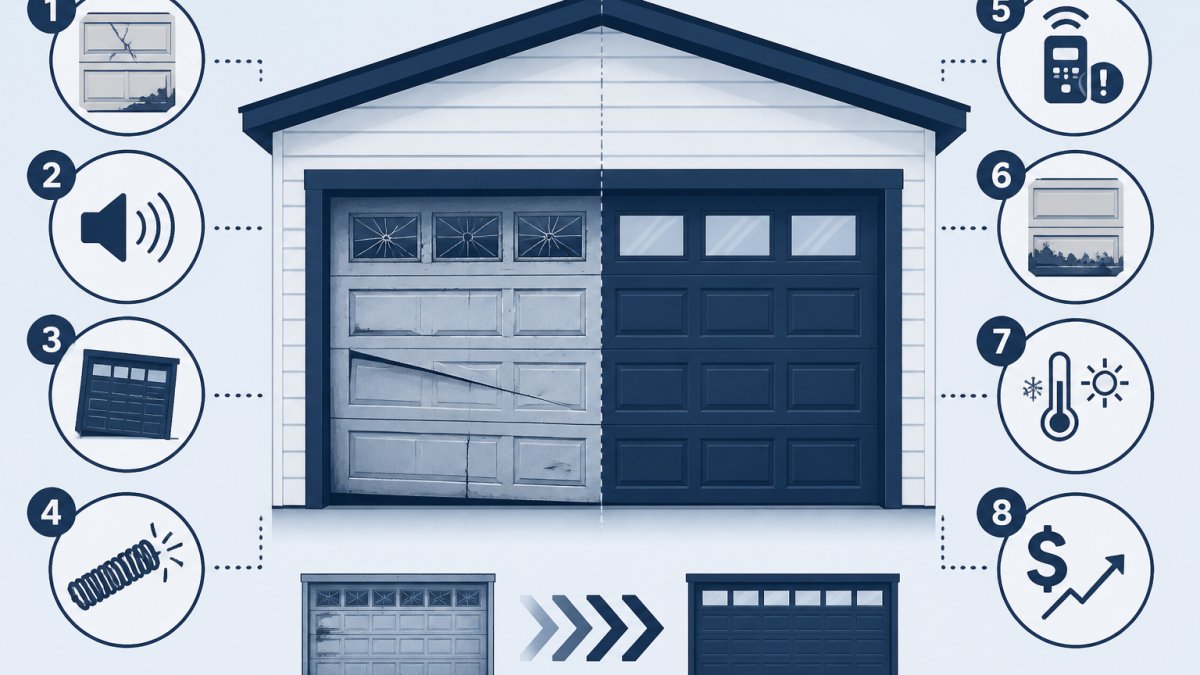
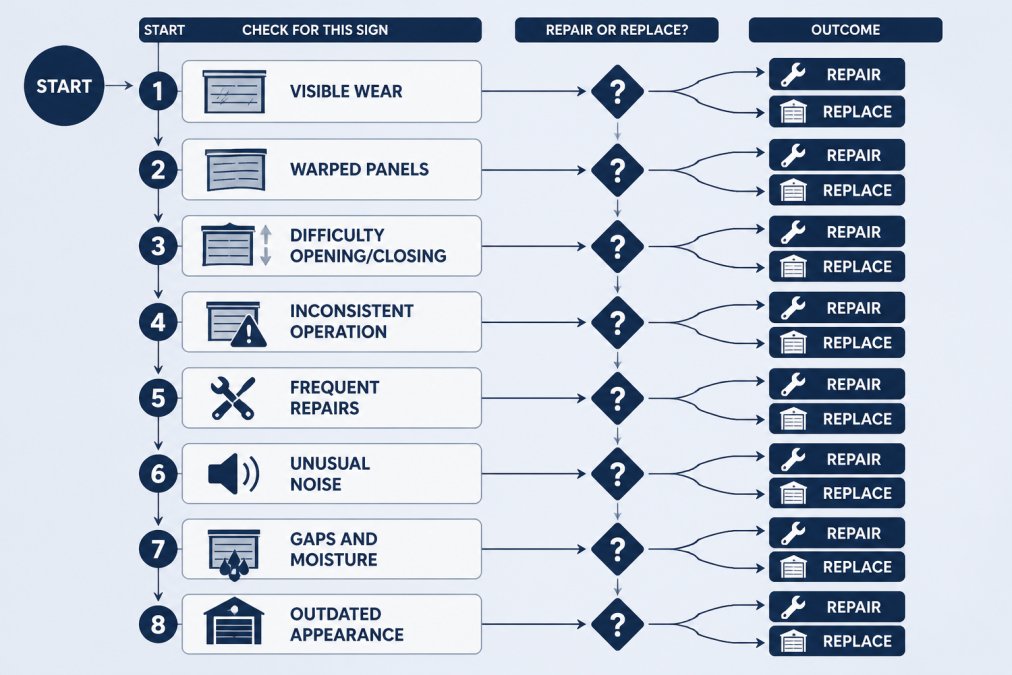
Here are the eight signs, in the order we check them:
- Visible wear, dents, and corrosion
- Damaged or warped panels
- Difficulty opening or closing
- Inconsistent operation
- Frequent repairs and recurring part replacement
- Unusual or excessive noise
- Gaps, moisture, and pest entry
- Outdated appearance dragging down curb appeal
(/24-hour-garage-door-repair-near-me/) typically lasts 15 to 30 years, depending on material, usage, and service. That range sets your baseline: a 20-year-old door with one problem is a repair candidate; the same door with four problems is usually a replacement.
Lifespan by Material and Usage
Material and daily cycles drive the numbers more than anything else:
- Steel: 15 to 20 years with regular maintenance
- Wood: 15 to 20 years, but needs more weather protection
- Aluminum: 15 to 20 years, lighter and rust-resistant
Usage matters just as much. A household running the door four times a day ages far slower than a warehouse cycling it dozens of times daily, which is why commercial overhead doors need heavier-duty hardware and more frequent service.
Signs You Need a New Garage Door vs. a Simple Repair
One failing part usually means repair. Several failing parts, or a door near the end of its lifespan, usually means replacement.
A snapped spring, a dead opener, or a misaligned sensor are normal repair jobs. Warped panels, rusted-through sections, and a door that’s been repaired repeatedly are replacement territory. If you’re unsure, a professional inspection settles it in one visit.
Garage Door Repair vs Replacement: A Decision Framework
Most articles tell you to ‘call a professional’ when you’re unsure. That’s not a framework, it’s a shrug. Here’s the actual decision logic, built around four variables you can assess yourself.
The Four Variables
1. Age relative to expected lifespan. A steel door rated for 15 to 20 years that fails at year 8 is a repair candidate.
2. Repair frequency. One repair in five years is normal wear.
3. Severity and location of the failure. Failures fall into three tiers:
- Tier 1, Wear components (repair): rollers, hinges, weather seals, bottom rubber, lubricant, photo-eye sensors, opener remote or logic board. These are designed to be replaced and don’t indicate structural decline.
- Tier 2, Mechanical systems (repair or replace, depends on age): torsion springs, extension springs, cables, drums, opener motor or drive. A single spring failure on a 10-year-old door is a straightforward repair. A spring failure on a 20-year-old door with rusted panels usually tips toward replacement because the next failure is already loading.
- Tier 3, Structural (replace): warped or delaminated panels, rust perforation through the panel skin, bent or cracked track sections that can’t be realigned, a door that has come off its tracks after impact, or a door frame that has shifted. These aren’t repaired, they’re replaced.
4. Safety status. Any condition that can’t be made safe with a standard repair moves the door into replacement territory.
The Repair-vs-Replace Decision Table
| Situation | Best Move | Reasoning |
|---|---|---|
| Door under 10 years old, one Tier 1 failure | Repair | Hardware is still within service life |
| Door under 10 years old, one Tier 2 failure (spring, cable, opener) | Repair | Door structure is sound; component is serviceable |
| Door 10-15 years old, one Tier 2 failure, no rust or warping | Repair, then reassess annually | Door has remaining life; watch for repeat failures |
| Door 15-20 years old, two or more repairs in the past 12 months | Lean replace | Cumulative repair spend is approaching replacement cost |
| Door 15-20 years old, one Tier 2 failure plus visible rust or warping | Replace | Structural decline is underway |
| Any age, Tier 3 structural failure (warped panels, rust perforation, off-track after impact) | Replace | Panels and track can’t be reliably restored |
| Opener fails, door itself is sound and under 15 years old | Repair or replace opener only | Door and opener are separate systems |
| Door over 20 years old with any Tier 2 or Tier 3 failure | Replace | Past expected service life; next failure is likely |
| Door fails the reversal test after adjustment | Replace or repair based on cause | Safety cannot be compromised |
The Cost-Crossover Rule
A useful rule of thumb: when the quoted repair cost reaches roughly one-third to one-half of what it would cost to replace garage door units installed, and the door is past the midpoint of its expected lifespan, replacement is usually the better financial decision. The exact crossover depends on size, material, and insulation, but the principle holds, don’t sink major money into a door in its final third of service life.
Door Problem or Opener Problem?
This distinction saves people money every week. The door is the panels, tracks, springs, cables, and hinges. The opener is the motor and drive system that lifts it.
Quick test: disconnect the opener (pull the emergency release handle) and lift the door by hand. If it moves smoothly and stays where you put it, the door is balanced and the opener is the problem.
Age sets the baseline, repair frequency sets the trend, severity sets the tier, and safety sets the floor. When two or more of those point toward replacement, stop repairing.
Garage Door Replacement Cost: What Drives the Price
Replacement pricing depends on door size, material, insulation level, and whether the opener and hardware are replaced at the same time. We don’t quote numbers over the phone because the variables are too wide, but we give free quotes on site before any work begins, and the quote you get is the price you pay.
The biggest cost factors:
- Door size (single vs. double)
- Material (steel, wood, aluminum, fiberglass)
- Insulation rating
Safety Checks and Urgent Warning Signs
Garage doors are the largest moving object in most homes, and the hardware that lifts them stores enough energy to cause serious injury. Knowing what you can safely check yourself, and what you should never touch, is the difference between a maintenance task and an emergency room visit.
Stop Using the Door Immediately If:
- You hear a loud bang from the garage and the door won’t lift. This is almost always a snapped torsion spring. The door may weigh well over 100 pounds without spring counterbalance, and it can fall without warning. Do not try to open it by hand. Do not stand under it.
- The door has come off its tracks. A door that has jumped the track or is hanging unevenly is unstable. Keep everyone clear and call for service.
- A cable is frayed, kinked, or hanging loose. Cables are under extreme tension. A failing cable can snap with enough force to cause severe injury. Do not attempt to adjust or remove it.
What You Can Safely Inspect
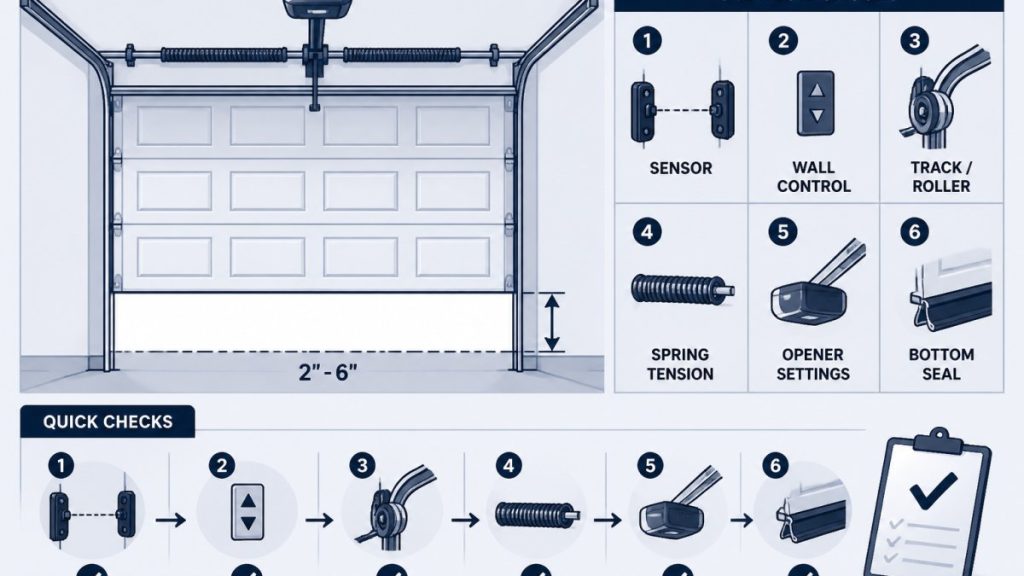
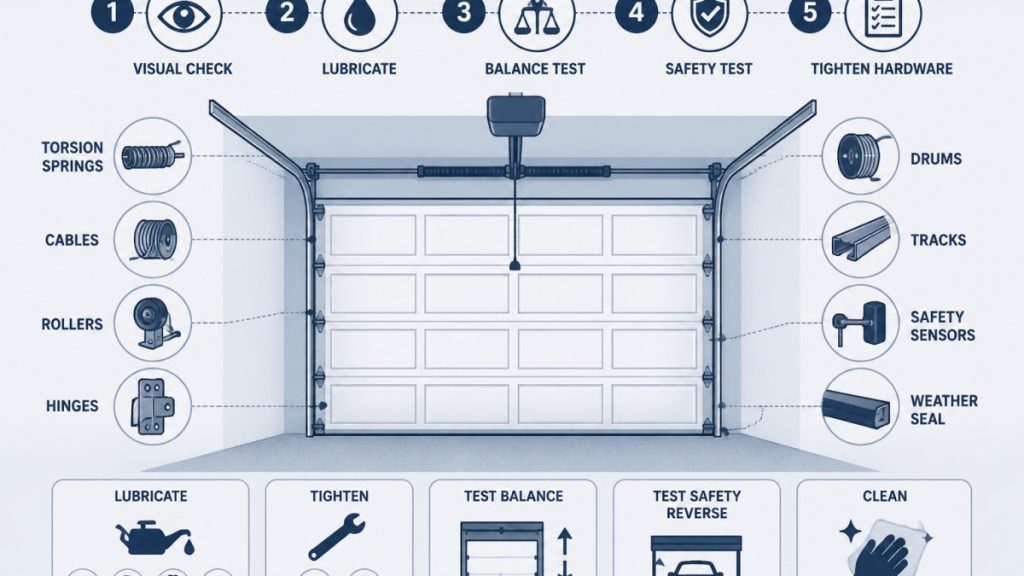
These checks need no tools and take about five minutes:
- Springs: Look at the torsion spring above the door (the horizontal coil) or the extension springs along the horizontal tracks. A gap in the coil, a stretched or distorted spring, or visible rust are warning signs. Do not touch them, just look.
- Cables: Check for fraying, kinks, or slack. Cables should be taut and evenly wound on the drums. If anything looks off, stop and call a technician.
- Rollers: Rollers should spin freely in the track. A flat spot, crack, or wobble means replacement is due. This is a safe, low-cost repair.
The Monthly Reversal Test
This is the single most important safety check you can do, and it takes 30 seconds:
- Open the door fully, then close it using the wall control.
- Place a 2×4 block of wood flat on the floor in the center of the door’s path.
- Press the wall control to close the door.
- The door should reverse within two seconds of contacting the block. If it doesn’t, the automatic reversal system needs attention before anyone uses the door again.
Also test the photo-eye system: with the door open, wave an object across the beam between the two sensors while the door is closing. The door should reverse immediately. If it doesn’t, the sensors need cleaning, realignment, or replacement.
What You Should Never Do Yourself
- Never adjust, remove, or replace torsion springs. These store enough energy to cause fatal injury. This is a licensed-technician job, full stop.
- Never remove or adjust cables or drums. Same reason, extreme tension.
- Never operate a door with a broken spring, even manually. The door can fall.
A garage door with a snapped spring can weigh well over 100 pounds and fall without warning. If you hear a loud bang from the garage, keep everyone clear and call for service rather than trying to open it. The same applies to any door that has come off its tracks or has a visibly damaged cable.
When to Call for Service vs. When to Replace
A failed spring, a dead opener, or a misaligned sensor are normal repair jobs. A door that has come off its tracks after an impact, a door with warped or rusted-through panels, or a door that has been repaired repeatedly is replacement territory. If you’re unsure, a professional inspection settles it in one visit, far cheaper than guessing wrong.
Insulation, Weather Sealing, and Energy Performance
An uninsulated door with worn seals lets heat out in winter and cool air out in summer, which shows up on your energy bills.
If your door is structurally sound but drafty, new seals and bottom weather stripping are a cheap first step. If the panels are warped or the door is old and uninsulated, replacement is the only way to get real energy performance.
Before replacing a door purely for energy reasons, check the bottom seal and side weather stripping first. A worn seal is often the entire problem, and it’s a fraction of the cost of a new door.
Frequently Asked Questions
How long does a garage door usually last?
Most garage doors last 15 to 30 years depending on material and maintenance. Steel doors typically run 15 to 20 years, while wood doors average 15 to 20 years with regular upkeep. Aluminum and fiberglass doors often exceed 20 years. Heavy daily use, coastal humidity, and skipped maintenance shorten lifespan. If your door is past 15 years and showing multiple warning signs, a professional inspection helps you decide whether repair or replacement makes more sense.
Should I repair or replace my garage door?
The decision hinges on age, damage extent, and repair frequency. A single broken spring or misaligned track on a door under 10 years old usually calls for repair. But if the door is over 15 years old, has warped or corroded panels, or needs repeated repairs, replacement is often the better investment. A professional inspection can confirm whether the door structure is sound or whether replacement will save money long term.
Does homeowners insurance cover garage door replacement?
Coverage depends on the cause of damage. Most homeowners insurance policies cover garage door replacement when damage results from a covered peril such as a storm, fire, or vehicle impact. Normal wear and tear, rust, and aging are typically excluded. Check your policy’s dwelling coverage limits and deductible before filing a claim. If the damage stems from gradual deterioration, replacement is usually an out-of-pocket expense.
What are the signs that a garage door needs to be replaced?
Key signs include visible dents, chipped paint, corrosion, warped panels, difficulty opening or closing, inconsistent operation, unusual or excessive noise, and frequent repairs. Gaps around the door that let in moisture, pests, or cold air also signal it is time. If your door is over 15 years old and showing two or more of these signs, schedule a professional inspection to determine whether repair or full replacement is the smarter move.
Garage doors rarely fail without warning. The signs build up over months, and the homeowners who catch them early spend less and stay safer. If you’re seeing any of the eight signs above, All Seasons Garage Door offers free quotes, around-the-clock availability for emergencies, and background-checked technicians who explain exactly what’s wrong before any work starts. Get started with All Seasons Garage Door and get a straight answer on repair versus replacement.